3.1 NISO's definitions
There are three main types of metadata:
• Descriptive metadata describes a resource for purposes such as discovery and identification. It can include elements such as title, abstract, author, and keywords.• Structural metadata indicates how compound objects are put together, for example, how pages are ordered to form chapters.
• Administrative metadata provides information to help manage a resource, such as when and how it was created, file type and other technical information, and who can access it. There are several subsets of administrative data; two that are sometimes listed as separate metadata types are:− Rights management metadata, which deals with intellectual property rights,
and
− Preservation metadata, which contains information needed to archive and preserve a resource.Source:
NISO. (2004) Understanding Metadata.
Bethesda, MD: NISO Press, p.13.2 Metadata functions
- Resource discovery
- Allowing resources to be found by relevant criteria;
- Identifying resources;
- Bringing similar resources together;
- Distinguishing dissimilar resources;
- Giving location information.
- Organizing e-resources
- Organizing links to resources based on audience or topic.
- Building these pages dynamically from metadata stored in databases.
- Facilitating interoperability
- Using defined metadata schemes, shared transfer protocols, and crosswalks between schemes, resources across the network can be searched more seamlessly.
- Cross-system search, e.g., using Z39.50 protocol;
- Metadata harvesting, e.g., OAI protocol.
- Digital identification
- Elements for standard numbers, e.g., ISBN
- The location of a digital object may also be given using:
- a file name
- a URL
- some persistent identifiers, e.g., PURL (Persistent URL); DOI (Digital Object Identifier)
- Combined metadata to act as a set of identifying data, differentiating one object from another for validation purposes.
- Archiving and preservation
- Challenges:
- Digital information is fragile and can be corrupted or altered;
- It may become unusable as storage technologies change.
- Metadata is key to ensuring that resources will survive and continue to be accessible into the future. Archiving and preservation require special elements:
- to track the lineage of a digital object,
- to detail its physical characteristics, and
- to document its behavior in order to emulate it in future technologies.
Source:
NISO. (2004) Understanding Metadata.
Bethesda, MD: NISO Press, pp.1-2.3.3 Getty's definitions on types of metadata
Type Definition Examples Administrative Metadata used in managing and administering collections and information resources
- Acquisition information
- Rights and reproduction tracking
- Documentation of legal access requirements
- Location information
- Selection criteria for digitization
Descriptive Metadata used to identify and describe collections and related information resources
- Cataloging records
- Finding aids
- Differentiations between versions
- Specialized indexes
- Curatorial information
- Hyperlinked relationships between resources
- Annotations by creators and users
Preservation Metadata related to the preservation management of collections and information resources
- Documentation of physical condition of resources
- Documentation of actions taken to preserve physical and digital versions of resources, e.g., data refreshing and migration
- Documentation of any changes occurring during digitization or preservation
Technical Metadata related to how a system functions or metadata behaves
- Hardware and software documentation
- Technical digitization information, e.g.,
- formats, compression ratios, scaling routines
- Tracking of system response times
- Authentication and security data, e.g., en cryption keys, passwords
Use Metadata related to the level and type of use of collections and information resources
- Circulation records
- Physical and digital exhibition records
- Use and user tracking
- Content reuse and multiversioning information
- Search logs
- Rights metadata
Source:
Murtha Baca ed.(2008).
Introduction to Metadata Version 3.
Getty Information Institute. Table 2.3.4 Dublin Core's elements outline
DUBLIN CORE Metadata Element Set (= "simple Dublin Core)
Website: http://dublincore.org/
DC Element set
Content Intellectual Property Instantiation Coverage Contributor Date Description Creator Format Type Publisher Identifier Relation Rights Language Source Subject Title
Additional notes
Majority of the descriptive metadata are manually created (refer to Section 2) using various tools (refer to Section 5).
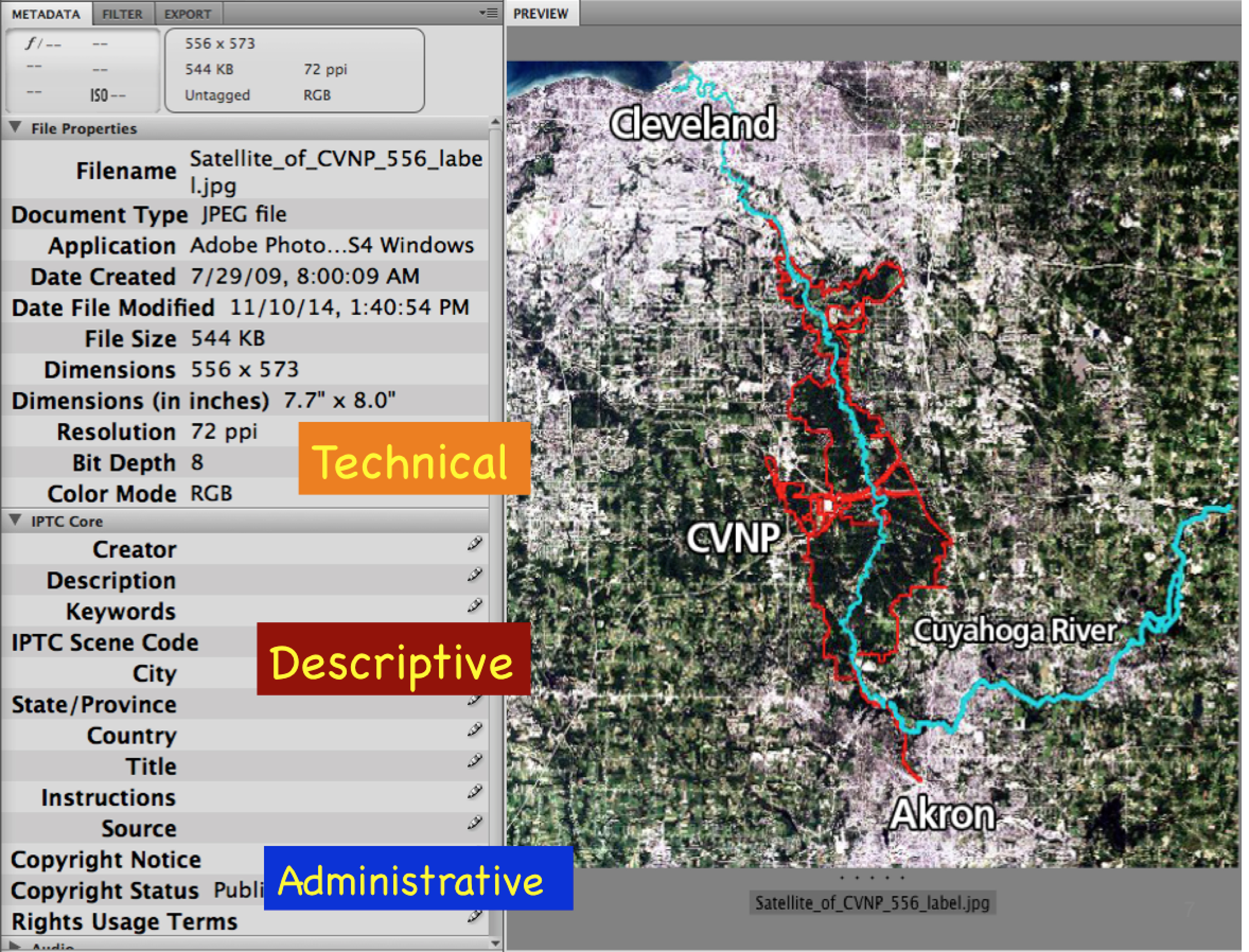
Technical metadata may be automatically captured by a software.
- E.g., what is the resolution of this satellite image? What is its size? Will it be too large to download to a smart phone or too small to zoom-in? -- Adobe Bridge can help to provide technical metadata for each digital file like this.
Use metadata can be learned.
- Publishers, social media, and marketing services have been using such data collected based on usage
- e.g., about a published or posted item: number of times is has been viewed, downloaded, discussed, reviewed, recommended, shared, or cited, and viewed or bought together with another thing.
Descriptive metadata can also be crawled through computer programing or APIs.